Approach by Businesses Toward Environmental Conservation
Decarbonization Initiatives at Business Sites
The OKI Group's business sites are promoting decarbonization efforts by improving efficiency (energy saving) and introducing renewable energy.
Improving efficiency (energy saving)
Our main focus is to improve the operation of on-site facilities and upgrade facilities to higher efficiency, with a target of 1% or more per unit of energy consumption.
| Energy saving measures |
|
|---|
Introduction of Renewable Energy
The OKI Group is promoting a balanced approach to introducing renewable energy, such as adopting solar power generation at business sites and purchasing renewable energy certificates. In fiscal year 2023, we exceeded our CO2 reduction targets. Moving forward, we will continue to enhance our strategies for implementing renewable energy and drive decarbonization alongside our traditional energy-saving measures.
| Renewable energy cases | In July 2022, the Honjo Plant, which received Japan’s first ZEB(*) certification, began full-scale operations. In fiscal year 2023, non-fossil certificates were purchased, and in April 2024, solar panels were installed at OKI Nextech’s Komoro Plant. |
|---|---|
| OKI Engineering, which provides reliability evaluation and environmental protection technology services within the OKI Group, aims to achieve zero CO2 emissions from electricity usage at all five of its sites by fiscal year 2025, realizing a "Carbon Neutral Test Lab." Since fiscal year 2022, OKI Engineering has been advancing the implementation of renewable energy. This initiative aims to eliminate CO2 emissions generated by its contracted testing and evaluation services, contributing to reducing CO2 emissions in the customer supply chain. |
*ZEB (Net Zero Energy Building): A building that aims to reduce the balance of primary energy consumed by the building to zero by creating energy from renewable energy sources and conserving energy through the use of highly insulated structures and sensors, while also realizing a comfortable indoor environment. (Energy consumption by production facilities, office equipment, etc. is excluded from the calculation of ZEB.)
Environmental Measures According to Site Characteristics
Environmental measures at each site are promoted according to their characteristics. For example, decarbonization activities are classified into processing plants mainly for painting and plating, assembly plants for component packaging, large-scale offices, and small-scale offices, and measures are promoted according to their characteristics.
As an example, processing plants are characterized by continuous operation of production facilities and air conditioning equipment. For these we are primarily working to achieve a fixed reduction in energy consumption. The assembly plant has the characteristic of a low fixed load and energy consumption that fluctuate according to production volume. Based on the fact that high-mix low-volume production is increasing, efficiency is being promoted through measures such as cell production, unit production, and change in layout. In our large offices, we are promoting improvements through the introduction of energy-efficient air conditioning equipment and lighting fixtures, and in smaller offices we are making improvements centered on energy conservation activities and other operational aspects.
The OKI Group aims for optimization across the entire Group by implementing such measures and setting targets according to site characteristics, conducting trials for common issues, and horizontally developing effective cases to other sites.

Processing plants
For the purposes of global warming prevention work, OKI Group sites are classified into different categories to enable prevention measures tailored to the characteristics of each category. The categories are processing plants (mostly for painting and plating), product assembly plants (mostly for mounting parts), large offices and small offices.
Challenge to achieve both delicate quality control and CO2 reduction in the press process

At OKI Sympho-Tech Co., Ltd. (OSC), which consists of two businesses: sheet metal processing for outdoor housings and custom power supply manufacturing, we reviewed the operating methods of press equipment used in metal bending, which is our specialty, and obtained significant effects in reducing CO2 emissions and costs.

The bending of some products (stainless steel spring steel plates), which require higher quality, is performed by a special equipment using a hydraulic motor. However, if the temperature is not kept constant, the volume of oil will change and even if the product is processed at the same pressure, the bending finish will change significantly. The hydraulic pressure of the motor varies from 500 grams to more than 100 tons depending on the thickness and length of the metal to be bent, the material to be bent, and the angle to be bent. However, if the adjustment is incorrect, the material will bend back the moment the pressure is released after work, which is known as a spring back problem.
For this reason, the company had to leave the equipment in standby mode for quality reasons. In this project, by optimizing the standby time of press equipment while ensuring quality, we succeeded in reducing electricity and CO2 emissions by approximately 80% and ensuring quality with this equipment alone.
90% Energy Savings in Continuously Operating Equipment

OKI Circuit Technology (OTC), which manufactures high-reliability printed circuit boards etc. used in space, is promoting the reduction of fixed energy consumption in production facilities that operate non-stop.
One of these, the desmear processor, is equipment that melts and removes the shavings (smear) remaining on the drilled surface of the board, and constantly consumes electric power. Since a large amount of heat is emitted by the equipment when maintaining the interior at a high temperature for the melt treatment, gas was necessary for supplying steam for heating and maintaining the inside temperature of the equipment, and electric power was required to cool the room and prevent the temperature from rising around the equipment, which was a problem in terms of energy conservation.
As a countermeasure, we succeeded in suppressing the external heat release and reducing the surface temperature from 75℃ to 28℃ by covering the surface of the equipment with a heat insulating material. In order for it to be able to withstand the heat of the equipment, we selected a heat insulating material made of fluororesin and glass fiber. Thanks to these measures, we reduced the energy by an equivalent of 94% of the conventional equipment alone and succeeded in reducing costs.
Improvement of Energy Efficiency Through Review of Air Conditioning Balance

In the copper plating room of OKI Circuit Technology, the exhaust system used to operate at full power, but it produced a strong and unique odor, which was a problem. As a result of a survey, two reasons were identified concerning the dedicated exhaust system (local exhaust system) which evacuates the processing solution vapor emitted by the plating tank.
(1) There was a large gap between the local exhaust system and the plating tank, through which the vapor of the processing solution escaped, and copper compound was precipitated around the plating tank.
(2) While the local exhaust system air volume was set too high, the amount of outside air entering the room was small and sufficient ventilation was not achieved, resulting in vaporized chemical substances diffusing inside the room.
With respect to (1), a diffusion prevention wall was established as a countermeasure, and for (2), the balance between the volume of the local exhaust system and the amount of outside air entering the room was adjusted to achieve the proper flow of air to the local exhaust system.
Through these measures, we promoted an improvement in the work environment, a reduction in environmental impact, an improvement in energy efficiency of the local exhaust system etc., and a reduction in production costs.
PFC greenhouse gas elimination rate of at least 99%
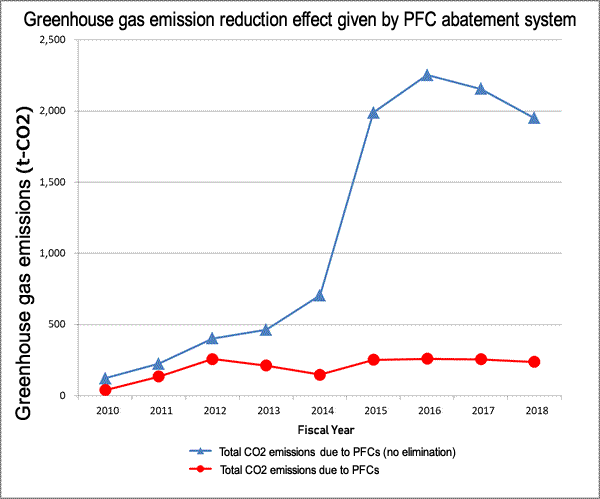
OKI's LED plant has started using dry etching processes to increase the competitiveness and improve the quality of the semiconductor devices it produces. Some of these processes use greenhouse gases called PFCs as reaction gases. Reducing emissions of these gases is a key issue since they are decomposition-resistant and have high global warming potentials (GWPs) of about 7,000 to 20,000 or more.
The plant has taken aggressive measures against global warming. In FY 2015, it started installing abatement systems designed to break down PFC gases as one way of reducing greenhouse gas emissions caused by these gases.
The systems have been highly effective, attaining an elimination rate of at least 99% in a sampling-based performance assessment. (The OKI Group's estimates of greenhouse gas emissions are calculated using a figure of 90%, in conformance with the value of 'at least 90%' given by the abatement system manufacturer.)
Product assembly plants
Energy-saving Using Projection Mapping
Issues with high-mix low-volume manufacturing / multiple parts

OKI’s Mechatronics System Plant manufactures ATMs, cash handling equipment, check-in terminals and the like. The plant handles as many as 10,000 pieces, the largest number in the OKI Group. In order to produce a high-mix lowvolume manufacturing in accordance with the specifications of each customer, the accurate picking of parts without omission by workers posed a challenge to raising the proficiency and efficiency of work.
A system to support the passing on of skilled techniques
Accordingly, we realized a parts picking system applying projection mapping technology to project images in 3D.
When starting work, this system projects a stipulated work procedure manual from a projector onto the workbench. If the worker moves to take the necessary parts from the shelf according to the procedure manual, a green arrow and a number projected from the projector indicate which shelf the part is on how many to take. The camera and sensor behind the worker detect when the worker places a hand on the wrong parts shelf, and the color of the shelf turns red. In addition to this, functions that inform of real-time improvements in work efficiency based on motion analysis are incorporated, accelerating the acquisition of skilled techniques and improvements on the shop floor.
1/4 the investment, 1.5 times the energy efficiency
In the previous system, detection LEDs and sensors were installed on each part shelf, making the apparatus complicated and costly.
The current system has improved the energy consumption rate, which expresses production efficiency, by 1.5 times while reducing capital investment to 1/4 of the previous system. This leads to energy-savings and cost improvements.
"Solder Revolution" Yields Reduction of 70% in Power and Resource Consumption

OKI Nextech has made innovative reforms to their manufacturing line and reduced power consumption by 74% and the amount of solder used by 70% in the process of soldering electrical components to printed circuit boards.
This production reform or "solder revolution" is led by the "point DIP" machines brought into the printed circuit board assembly line.
Until now the entire printed circuit boards had been dipped into a solder tank and the components then soldered on, requiring a large amount of power to melt the solder. The newly-introduced point DIP machines have enabled pin-point soldering at the exact locations necessary, drastically reducing the consumption of electricity and solder.
Visualization of Operational Status - 90% Energy Savings by Mode Switching

OKI Nextech, which mounts electronic components on printed circuit boards, succeeded in considerable energy savings by coupling the operation mode to the operation status of equipment.
In the process of mounting electronic components, the bond is used to temporarily fix large parts before soldering and a hardening furnace to harden the bond by heating.
As a result, the previously fixed energy consumption of the bond hardening furnace became a lean consumption that responds to fluctuations in production volume, achieving a 90% energy saving for the hardening furnace alone.
At OKI Nextech, it was impossible to lower the amount of energy used in the hardening furnace, despite a decrease in the amount of bond used due to the downsizing of parts and progression of mounting technology, which was a challenge. The reason for this was that the hardening furnace was often left in high-temperature operation mode because its operation status was not known by operators or managers.
As a countermeasure, the state of the hardening furnace was monitored by a sensor and the operator was notified by the color of a lamp on the equipment when a certain non-operation time had passed, thereby prompting the operator to switch the hibernation mode. For the case the operator does not notice the notification, we created a mechanism that allows the manager to instruct the operator in response to an automatic notification sent wirelessly to the manager’s PC.
large offices
System Development Center Receives Award for Energy-saving

The OKI System Center located in Warabi city, Saitama Prefecture, is the center of our systems development with about 2,600 workers. A large number of servers and other information communication equipment are installed here, and since it is one of the leading consumers of energy within the OKI Group, we are constantly devising ways to improve the efficiency of air conditioning and lighting here.
Specifically, we have updated the gas-fired cold/hot water generator used for air conditioning to a heat pump type, proceeded with countermeasures such as quadrupling efficiency, and realized substantial energy reductions. In 2016, we received awards from Saitama Electric Power Association and the Saitama Prefecture Governor.
Pollution Prevention
Chemical management and reduction activities
The OKI Group works actively to reduce harmful chemical emissions. This section presents some examples of our work on reducing chemical emissions by using approaches such as reviewing manufacturing methods and finding alternatives to chemicals used in processes.
Trial to Eradicate a Source of Pollution

Issue arising from continuation of plating work
In the plating process, the parts are attached to hangers, put in a basket, and soaked in the plating solution. As this process is repeated, plating becomes attached to equipment other than the parts, such as the hangers and the basket, which affects the work. It is therefore necessary to periodically remove the plating adhered to the equipment with nitric acid.
Nitric acid has been designated as a deleterious substance in the Poisonous and Deleterious Substances Control Act and it was used at the Mechatronics System Plant in the volume of 8,000 liters per year, which has been an issue.
Trial application of Teflon technology
"If we can stop the equipment from becoming plated, then we won’t need nitric acid" - The Mechatronics System Plant has been implementing Teflon processing of the cage. If the plating fluid is repelled and does not adhere to the basket, the basket will not become plated and harmful nitric acid will be unnecessary. Against the background of the technical evolution of Teflon processing, the Mechatronics System Plant trialled several methods and is verifying the cost-effectiveness of the results. This technology is expected to be rolled out to other manufacturing sites as an effective method of eradicating a source of pollution.
Reduction of Chemical Substances by Innovation of Manufacturing Method

In 2015, OKI Nextech introduced a point-dip (DIP) apparatus that scales-down the conventional method of immersing a substrate in a solder bath to pinpoint soldering for some of the processes to solder electronic components to circuit boards. In 2017, we increased the number of units and increased the rate of operation from 57% to 70%.
Flux is sprayed on the part to be soldered for pre-cleaning and prevention of oxidation. Isopropyl alcohol (IPA) is the main component of the flux. While IPA is relatively inexpensive and has high detergency, etc. it is highly toxic and is regulated by laws and regulations, so reduction of its use was an issue.

At ICT Systems NUMAZU Plant, the manufacturing process for products to be used underwater involves work to fix parts with adhesive. Conventionally, the adhesive contained dichloromethane, which has a high environmental impact and strong toxicity, so measures were taken such as using local exhaust equipment to prevent workers from inhaling the steam. As the amount used at the plant already exceeded 200 kg per year and is expected to increase significantly as production increases, we have decided to switch to dichloromethane-free adhesives.
In replacing the adhesive, it was expected that the reliability test would be prolonged due to the strength required for underwater use and the long service life, but the design, manufacturing and quality divisions closely cooperated to review the items and objectives of the test, and were thereby able to significantly accelerate evaluation and application to the product.
Dichloromethane has been completely abolished at this plant and we are also promoting the reduction of hazardous chemical substances in other products.
Resource Recycling
Saving and Recycling of Resources Activities
The OKI Group is working on improving resource recycling without sacrificing productivity or quality.
Environmental Activities Enjoyed Through Reuse and Recycling
-

A "zero yen reuse" corner set up in one corner of the company
-

Printers PV 701 produced at ODMES. White letters painted on the shelves of waste pallets are printed at PV 701.
-

Tables and benches made from waste pallets. The cushions were remade from shirts no longer needed.
There is a plant in Fukushima that has a community that enjoys environmental activities expand under the slogan "SDGs We Can Do Easily."
OKI Data MES Co., Ltd. (ODMES), a printer manufacturing plant, recycles waste materials generated in the plant and "zero-yen reuse" of unwanted items brought from home by employees.
It all started with the inspiration of a female employee. -It's a waste to just throw away things we no longer need at home, but it's a hassle to take them to a reuse shop. So why not create a system to hand them over to the person who want at the company we go to every day --
She developed this idea into an internal "zero yen reuse" initiative, which was approved by management.She immediately set about creating a place for the reuse community, but the cost of purchasing display shelves was a barrier. So she set their sights on scrap wood for the wooden pallets that were piled up in the factory for transport. With the help of volunteers, she processed these scrap pallets into display shelves.
Under the "zero yen reuse" initiative, they display the unwanted items brought from their homes on these display themselves made of our own waste pallets, and those who want them are free to receive them.
The waste materials production activities that started with this initiative spread to Employees, and the tables and benches made here are used for meetings and places to rest.
The environmental activities that they enjoy in this way have spontaneously developed into their own work on environmental issues and issues. ODMES 'environmental activities also include the desire to create a workplace where workers can be energetic.

Plastic reuse activities resulting from corporate integration

OKI Sympho-Tech Co., Ltd. (OSC) was created in 2020 through the merger of a company that manufactures sheet metal products, such as outdoor casings, and a company that manufactures custom power supplies, both located on the same premises.
The company has been actively engaged in environmental activities even before the merger, for example in the field of resource recycling in the sheet metal processing division.
- Visualization by measuring the weight of waste in each department
- Recycling of plastic cushioning materials and switching to paper
- Increased management of paint expiration dates from 600 types to 400 types Reduce paint inventory
These and other initiatives have been promoted under the leadership of management and environmental departments, and have produced results.
After the merger, the environmental divisions of the two companies were integrated, and the integration of environmental management regulations and documents, as well as measures to reduce environmental impact, were examined jointly by employees from each company.
One example of synergies resulting from the merger in environmental measures is the reuse of large amounts of used plastic packaging materials generated by the Power Development Division, which are used in the manufacturing process of the Sheet Metal Division.
At the Electric Power Development Division, purchased electronic components are delivered in plastic bags, and after parts are removed from the manufacturing process, most of them are discarded because they cannot be used in intermediate processes or for products to be shipped due to product characteristics.
As a result of this integration, the sheet metal processing division has been able to collect and reuse plastic bags, 80% of which are reused in the sheet metal processing division, and the remaining 20% are provided to all workplaces.As a result of these efforts, the amount of plastic packaging materials purchased by the sheet metal division was significantly reduced, and the amount of waste plastic generated was reduced by 26% from fiscal 19 to fiscal 20.
Water Resources
Initiatives to Reduce Water Consumption

Some production processes at OKI Circuit Technology’s main factory generate an acidic mist, resulting in acidic vapors. Acid-cleaning scrubbers remove harmful acidic components. The acid-cleaning scrubbers reuse mildly polluted wastewater from production processes as cleaning water for removing harmful components. This method recycles about 4,000 m3 of water yearly. Acidic components adsorbed by the scrubber cleaning water are detoxified in the wastewater treatment process and discharged to the sewage system.
Basic Initiatives for Factory Wastewater
Wastewater from our factories and offices is discharged only after it has been detoxified, in accordance with national laws. We analyze the discharged water periodically to ensure that we are maintaining appropriate conditions. Some factories handle heavy metal ions, but we remove these by wastewater treatment before discharging the water. We monitor our operations appropriately day to day to ensure that we are not impacting people’s lives or creating health problems.