Environmental Management
Basic Approach
The OKI Group Environmental Policy incorporates our desire to pass on a better global environment to the next generation. This Environmental Policy is the foundation of our environmental management, and we are promoting activities centered on decarbonization, resource recycling, and pollution prevention from a life-cycle perspective with our products and sites. Among them, OKI has identified addressing climate change, which has become increasingly important in recent years, and reducing environmental impact through products. To guide these efforts, we have formulated the OKI Group Environmental Vision 2030/2050 as the medium- to long-term environmental target for the entire Group.
Environmental Policy
OKI Group Environmental Policy
The OKI Group positions "Environmental Protection," as outlined in the OKI Group Charter of Corporate Conduct / OKI Group Code of Conduct, as its OKI Group Environmental Policy.
Environmental Conservation
In order to realize and pass on a better global environment, the OKI Group promotes environmental management and makes efforts to conserve the environment through its products and its business activities.
Environmental vision
OKI Group's Mid- to Long-term Environmental Targets OKI Group's Environmental Vision 2030/2050
Promote fusion of environmental and management concerns, leverage OKI’s comprehensive capabilities to develop and support safer and more convenient social infrastructure, and help achieve SDGs.
Ⅰ.Prevention of Global Warming
Target
OKI has been certified by the Science Based Targets initiative (SBTi) for the 1.5°C standard and the Net Zero standard.
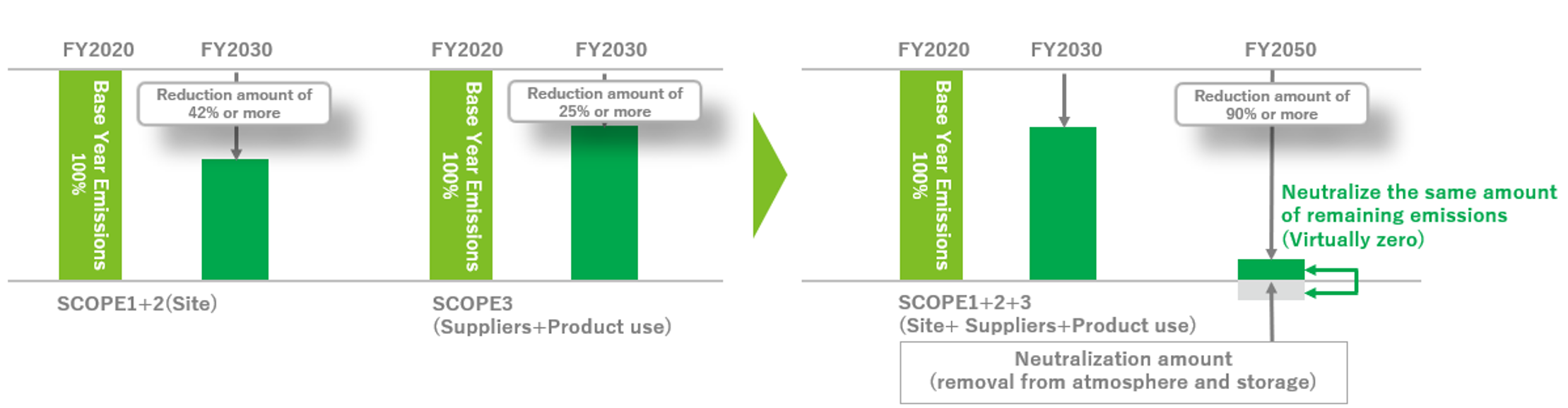
| FY2030 | SCOPE1 (CO2 generated by fuel use at company sites, leakage of alternative chlorofluorocarbons in air conditioners, use of company vehicles, etc.)+ SCOPE2 (CO2 generated from electricity use at company sites) | 42% CO2 emissions reduction at OKI sites (compared to FY2020) |
|---|---|---|
| Category 1 of SCOPE 3(CO2 generated from the manufacture of procured items related to purchased products and services.) Category 11 of SCOPE 3(CO2 generated by use of sold products.) | 25% CO2 emissions reduction at suppliers (compared to FY2020) | |
| FY2050 | Reduce CO₂ emissions from the entire value chain (Scope 1 + 2 + 3), including OKI site, by more than 90% compared to fiscal 2020, and to achieve net-zero emissions through carbon removal, etc. (In particular, achieve net-zero emissions from electricity consumption at OKI site and new products). | Net zero |
Measures
OKI Sites
Promote the following measures to achieve zero CO2 emissions at sites (ZEB, etc.)
- Ensuring energy conservation: Increasing the efficiency of production facilities and facilities at each site, increasing the efficiency of all operations.
- Introducing renewable energy: Installing renewable energy facilities at each site, contracting for electricity derived from renewable energy, etc.
Suppliers
- Strengthening communication with suppliers, procuring components from manufacturers with low CO2 emissions
Using Products
- Power saving in hardware products, technology development, selection of power-saving parts, and reduction in the number of parts
Ⅱ.Contribution to Achieving SDGs

FY2030
Through (i) and (ii) below, contribute to achieving the targeted reductions in environmental impact set out by the 2030 SDGs
(i) Generate innovative products and services and provide solutions conducive to resolving a wide range of environmental issues. Environmental Contribution Product Net Sales Ratio of 50% or more.
(ii) Realize innovative technologies for manufacturing and creating things in the value chain, including workplaces
FY2050
In addition to preventing global warming and adapting to climate change, we will promote innovation in products and services that contribute to solving environmental issues, and support social infrastructure by promoting development and provision.
Information disclosure in line with TCFD
TCFD Disclosure
Information Disclosed According to the Task Force on Climate-related Financial Disclosures (TCFD*1)
Amid the growing severity of climate change, the OKI Group sees it as our mission to pass on a better global environment to the next generation by addressing social issues. We promote environmental management by considering environment-related business risks and opportunities from a medium- to long-term perspective. OKI manages climate change efforts by categorizing them into two main areas: mitigation (preventing global warming, energy conservation, and expanding the use of renewable energy) and adaptation (responding to damage caused by extreme weather events, such as typhoons and flooding, which are thought to result from global warming). These efforts are disclosed based on the TCFD*1 framework, and the Company reviews its initiatives against the environmental management system ISO 14001 and the TCFD.
| Governance |
|
|---|---|
| Strategy |
|
| Risk Management |
|
| Indicators/Targets |
|
*1: TCFD (Task Force on Climate-related Financial Disclosures): Proposal that suggest the need for companies to disclose information to investors on their response toward climate change
Strategy and risk/opportunity management based on scenario analysis
We divide climate change scenarios broadly into two and conduct business while anticipating risks and opportunities. If the temperature rise reaches 3 to 4°C, physical risks such as intensified wind and flood damage will increase, so we are promoting BCM/BCP measures in the supply chain. At the same time, we expect increased needs for our areas of expertise, such as disaster prevention information systems, which the OKI Group positions as environmentally friendly products. As societal changes progress to limit the temperature rise to 1.5°C, the need for carbon-free products will increase, so we are promoting efforts to develop environmentally friendly products, such as energy-saving hardware products and expanding solutions that contribute to the decarbonization of customers and society.
| Scenario Analysis | Response to risk and opportunity process | |||||
|---|---|---|---|---|---|---|
| Category | Expected Phenomena |
Risk/ Opportunity |
Impact on Future Finances |
Time frame*3 | Monetary Impact*4 |
|
| 1.5˚C climatechange scenario*1 (transitional risks) | Growing and widespread demand for decarbonization | Risk |
|
Medium term |
Medium |
|
|
Medium term |
Small | ||||
| opportunity |
|
Medium term |
Medium |
|
||
| 4˚C climatechange scenario*2 (physical risks) | Increase and intensification of extreme weather events | Risk |
|
Short term | Large |
|
| opportunity |
|
Medium term |
Small |
|
||
*1: See IEA NZE 2050.
*2: See IPCC RCP8.5.
*3: Time frame definitions: Long term means more than 10 years, medium term means 3 to under 10 years, and short term means 1 to under 3 years
*4: Monetary impact definitions (in yen): Large means ¥10 billion or more, medium means ¥1 billion to less than ¥10 billion, and small means less than ¥1 billion
Promotion Structure
Our environmental management promotion system has been established and is operated based on the ISO 14001 environmental management system framework.
Based on our the OKI Group Environmental Policy, the OKI Group is managing the entire Group in a flexible and efficient manner with the aim of achieving a better global environment. Based on the "OKI Group's Environmental Policy" and "Environmental Vision 2030/2050", the OKI Group has formulated an environmental action plan and implemented management practices, and is actively engaged in activities to continuously reduce environmental impact through its products and business activities.
ISO14001
Environmental Management Systems
The OKI Group has obtained integrated certification for the international environmental management system standard ISO 14001 across the entire Group. Including locations that have independently obtained certification, ISO 14001 certification has been achieved at 100% of the 19 production sites both in Japan and overseas, including the major sites in Warabi, Takasaki, and Shibaura.
From fiscal year 2023, a Chief Environmental Officer has been appointed from among the executive officers to strengthen environmental governance, including climate change measures. The Chief Environmental Officer is responsible for drafting Groupwide policies and medium-term plans in the environmental field and is accountable for achieving the overall Group plan.
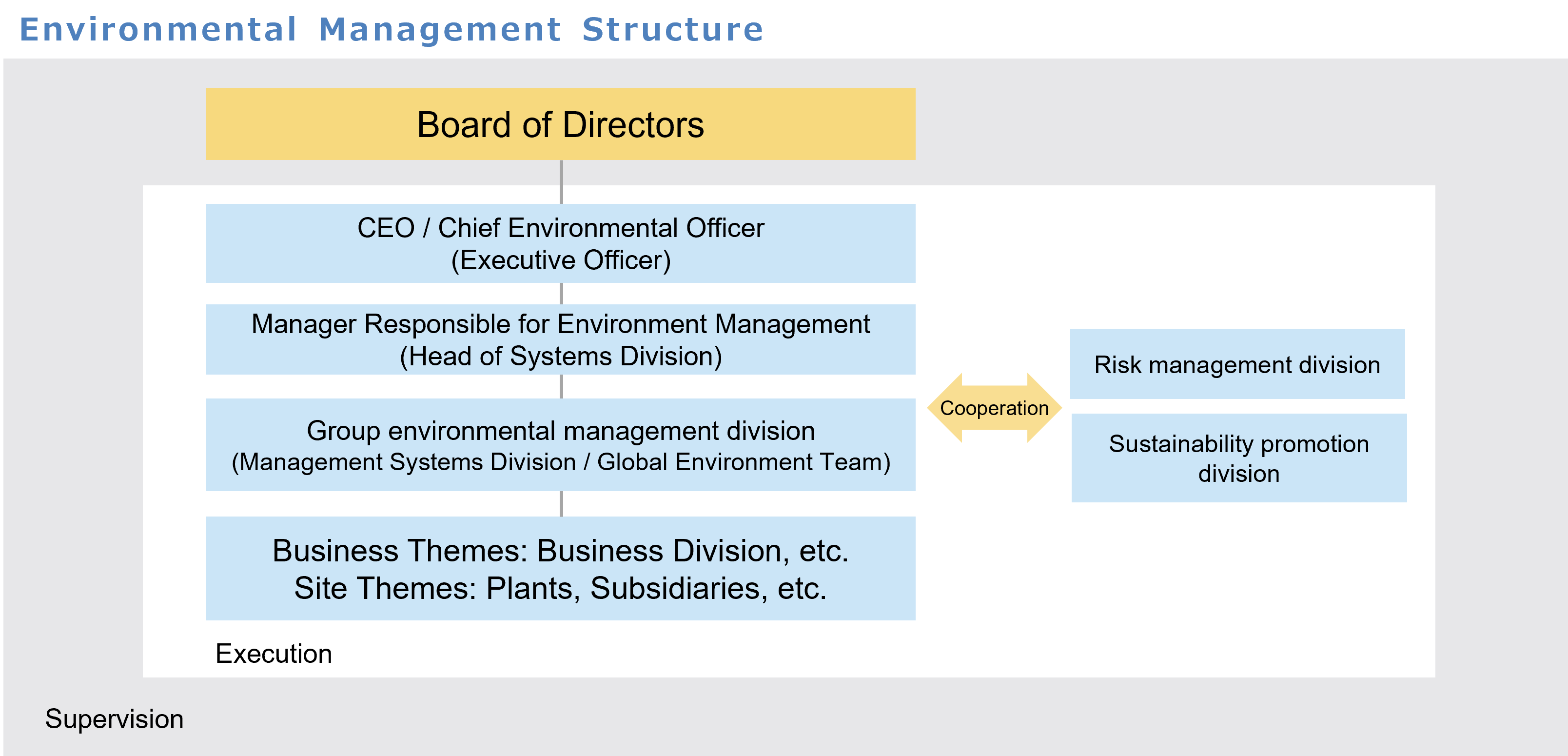
We are promoting the PDCA cycle by establishing systems for themes related to sites (Site themes) and product development and business (Busines themes).
By combining information on the two themes, we are efficiently promoting environmental management throughout the Group.
Planning → Execution → Monitoring/Measurement → Problem Analysis/Evaluation → Study/Trial of Countermeasures → Deployment of Measures within the Group. Through these continuous improvements, we are achieving synergistic effects across the Group.
The Scope of ISO14001 Certification
| Theme | Type | Site/Products Name | |
|---|---|---|---|
| Integrated Certification |
Site | Office |
|
| Factory |
|
||
| Group Companies |
|
||
| Product | OKI |
|
|
| Group Companies |
|
||
| Integrated Certification |
|
||
Coverage rate of ISO certification
- Results in FY2024 : 100%
- ISO certification coverage rate = Production value of companies with ISO certification ÷ Production value for the OKI group as a whole
Compliance with environmental laws and regulations
The OKI Group regularly assesses compliance with environmental laws and regulations and conducts internal audits at each site and division.
Our offices both domestically and internationally support laws, regulations, and policies related to climate change and energy consumption reduction, and we take appropriate measures to address them.
In fiscal 2024, there were no serious violations of environmental laws or regulations, including waste treatment and chemical substance management (water, air, and soil).
- Environmental Fines*
| FY2020 | FY2021 | FY2022 | FY2023 | FY2024 | |
|---|---|---|---|---|---|
| Number of cases | 0 | 0 | 0 | 0 | 0 |
* Environmental regulations including wastewater regulations (If any penalties are incurred, we will make it public.)
Environmental Education
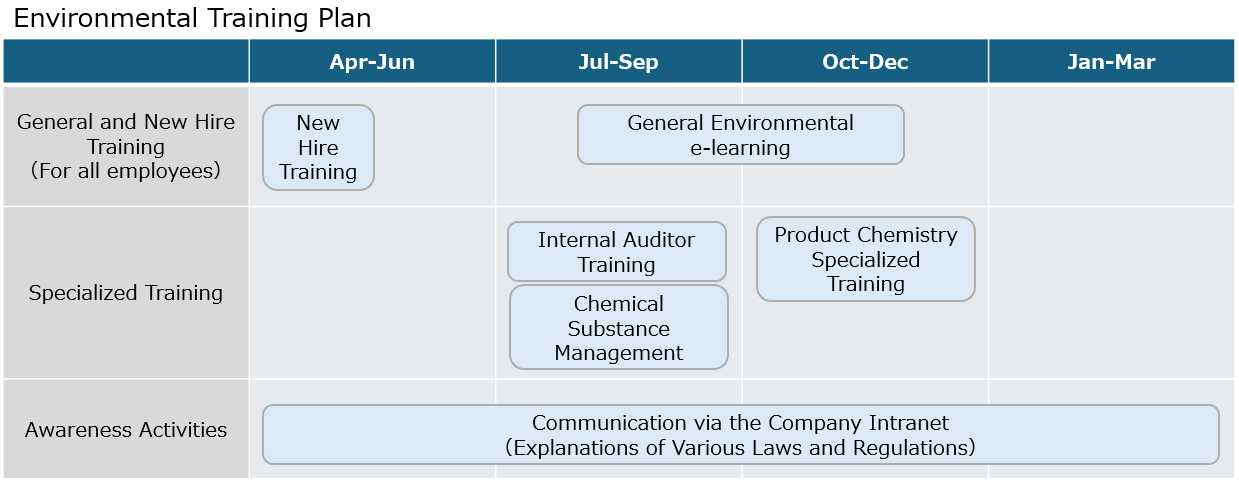
OKI Group provides all employees with opportunities for environmental e-learning to promote a basic understanding of environmental management. For employees responsible for environmental operations, we offer specialized training such as internal auditor training and chemical substance management. We also post explanatory materials on environmental laws and regulations on the company intranet and carry out awareness activities.
The participation rate for general environmental e-learning in fiscal year 2025 was 95.5%.
※ General environmental education includes content on waste management and chemical substance management.
Collaboration with external organizations
OKI participates in external organizations aimed at combating climate change, and is promoting initiatives and policy recommendations. *
In these activities, we regularly check whether the policies of the participating organizations are consistent with our own policies. If the policies of the participating organizations are found to be significantly weaker or inconsistent with our own environmental policy and environmental vision, we will consult with the organization and our internal staff. In the event that the differences cannot be resolved, our position will take precedence.
* For participation in international initiatives and organizations, please refer to "Sustainability Management."
Climate Change
Global Warming Prevention Liaison Committee
The Global Warming Prevention Liaison Committee is the Japan Electronics and Information Technology Industries Association, which aims to implement the "Carbon Neutral Action Plan" advocated by Keidanren. (JEITA). OKI will reduce life-cycle CO2 emissions, including at its sites, while taking into account the consistency with JEITA's Carbon Neutrality Action Plan. Our goal is to increase the number of environment-contributing products that contribute to carbon neutrality.
Challenge Zero (Challenge Net Zero Carbon Innovation)
The Japan Business Federation (Keidanren), in cooperation with the Japanese government, is working to establish an international framework for tackling climate change. The long-term goal of the Paris Agreement is to realize a "decarbonized society." It is an initiative that strongly transmits and supports actions at home and abroad. OKI does not stop at listing examples of "Challenge Zero," but also introduces innovations that lead to products and services that help solve a wide range of environmental issues. we will take on the challenge of creating.
Climate Change Initiative (JCI)
In April 2020, as a part of initiatives aimed at contributing to global warming prevention and the achievement of SDGs, OKI joined the "Japan Climate Initiative (JCI)," a network aiming for the realization of a decarbonized society. We will leverage co-creation with a broad range of partners aiming for decarbonization to strengthen our measures against climate change, and will contribute to the realization of a decarbonized society.
Saitama Prefecture Forest Creation Agreement
In order to protect and nurture Saitama prefecture's forests, which are the common property of the prefecture's residents, agreements are concluded between companies and organizations engaged in forest creation activities, municipalities that provide the locations for these activities, and the prefecture that supports these activities, and the parties work together to create forests. OKI has concluded the Saitama Prefecture Forest Creation Agreement with Woody Koike Co., Ltd. and Saitama Prefecture.
Pollution Prevention
CMP Consortium* (CMP : Chemical and Circular Management Platform) *Reorganized from JAMP (Japan Article Management Promotion Council).
This organization aims to create and disseminate a concrete mechanism for appropriately managing information on chemical substances contained in articles (another name for parts, molded products, etc.) and for smooth disclosure and communication within the supply chain.
OKI is working in cooperation with the CMP Consortium and participating companies to develop and disseminate "CMP," a platform for communicating information on chemical substances contained in products and resource recycling information.