Accommodation Control Technology for Heterogeneous PON Systems
Allocate equipment to minimize power consumption based on traffic volume
Keywords
Optical access, PON, PtP/PtMP, APN, Hollow Core Fiber
Technical Overview
With the widespread adoption of new lifestyles such as telework, the distribution of ultra-high-definition video, and the development of a digital twin society leveraging cutting-edge technologies-implementing generative AI-communications traffic is growing rapidly, and the resulting increase in power consumption has become a significant challenge. To address these challenges, there is a need for high-capacity, low-power optical communication networks as part of the social infrastructure.
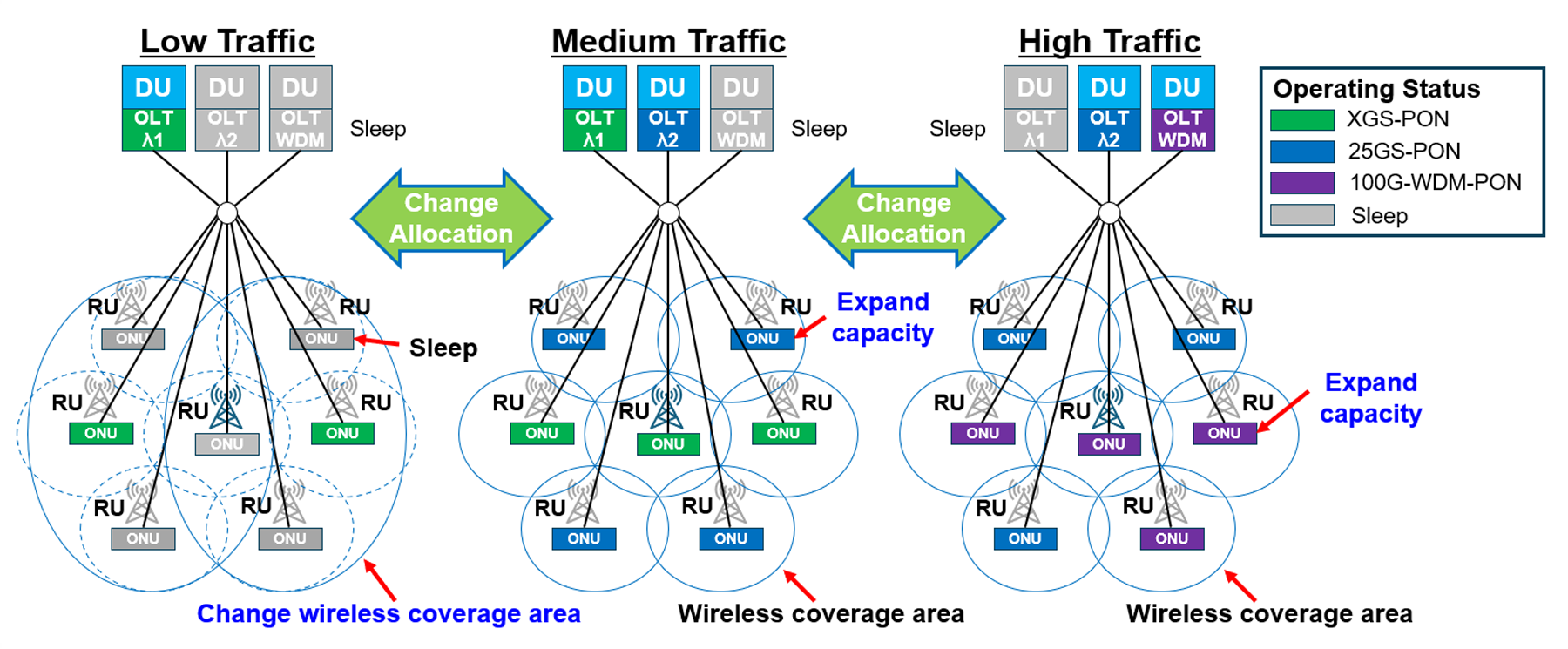
That's why, to achieve integrated accommodation (resource) control, increased capacity, and lower power consumption in optical access networks, we conducted research and development on accommodation control technologies for heterogeneous PON systems (XGS-PON, 25GS-PON, and 100G-WDM-PON). When this technology is applied to mobile systems, it can reduce unnecessary power consumption by controlling accommodation based on traffic volume. Specifically, (A) 100G-WDM-PON is used during periods of high traffic volume, (B) 25GS-PON and XGS-PON are used during periods of moderate traffic volume, and (C) only XGS-PON is used during periods of low traffic volume. Note that 100G-WDM-PON uses Point-to-Point (PtP) communication, while XGS-PON and 25GS-PON use Point-to-Multi-Point (PtMP) communication.
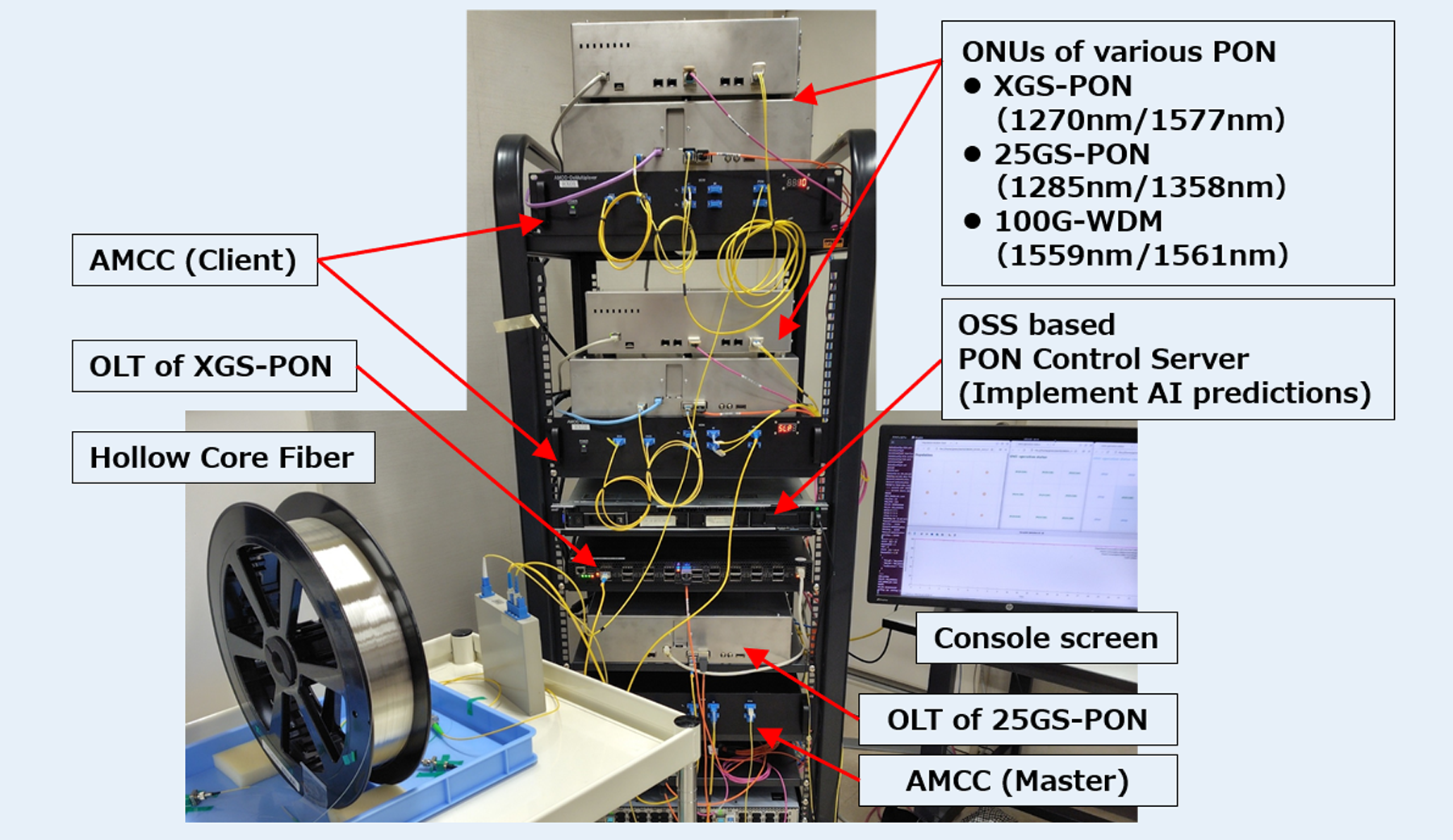
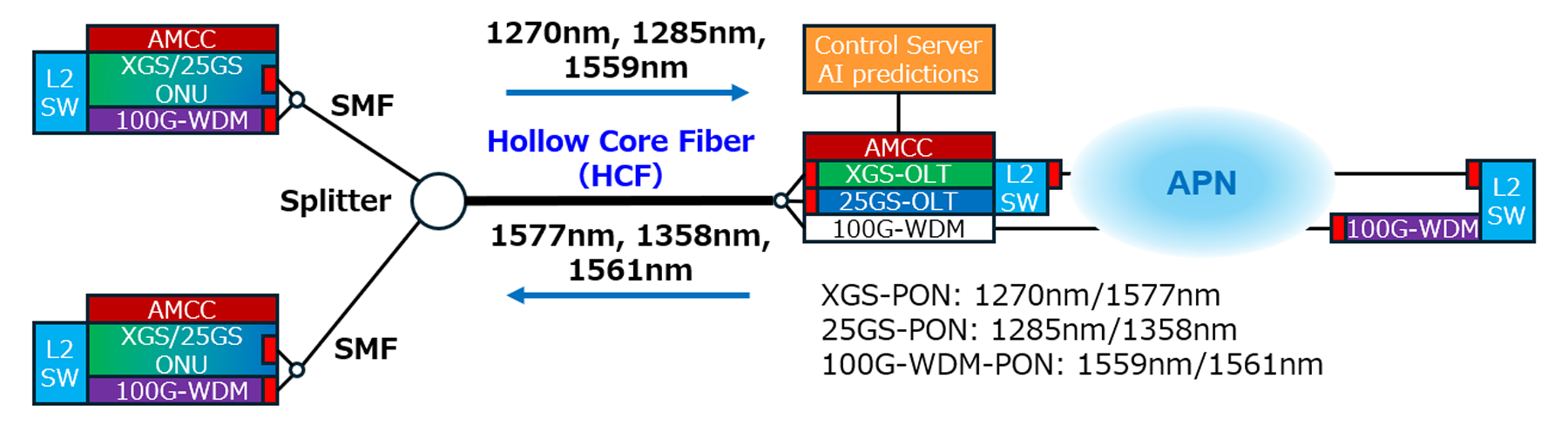
In addition, we confirmed that there were no issues when transmitting wavelength multiplexed signals from heterogeneous PON systems over the broadband hollow-core fiber-which features low signal loss across a wide range of wavelengths, including the O-band, C-band, and L-band-developed by our collaborative partner, Lightera Japan Co., Ltd. Specifically, XGS-PON used 1577 nm for downstream and 1270 nm for upstream; 25GS-PON used 1358 nm for downstream and 1285 nm for upstream; and 100G-WDM-PON used 1561 nm for downstream and 1559 nm for the upstream. We transmitted wavelength multiplexed signals at 1358 nm, 1561 nm, and 1577 nm in the downstream direction, and wavelength multiplexed signals at 1270 nm, 1285 nm, and 1561 nm in the upstream direction, bidirectionally over a single hollow core fiber.
What are OKI's unique strengths?
Leveraging its expertise in optical access technology and system design, OKI has developed PON systems (XGS-PON, 25GS-PON, 100G-WDM-PON) with varying speeds and implemented switching functions that enable optimal accommodation control based on traffic volume forecasts. This control mechanism implements the AMCC method, which superimposes low-frequency signals that do not affect the data signals. By using AMCC via open-source-based management software to switch the optical wavelengths handled by user equipment (ONUs), it enables the transition to different PON systems. This switching mechanism reduces power waste and enables us to provide a low-power optical access system (FTTHx service) that, in theory, can reduce power consumption to one-tenth of that of conventional systems. In addition, by using AI to predict traffic fluctuations, the system can automatically select the optimal PON system that minimizes power consumption.
What is the target market?
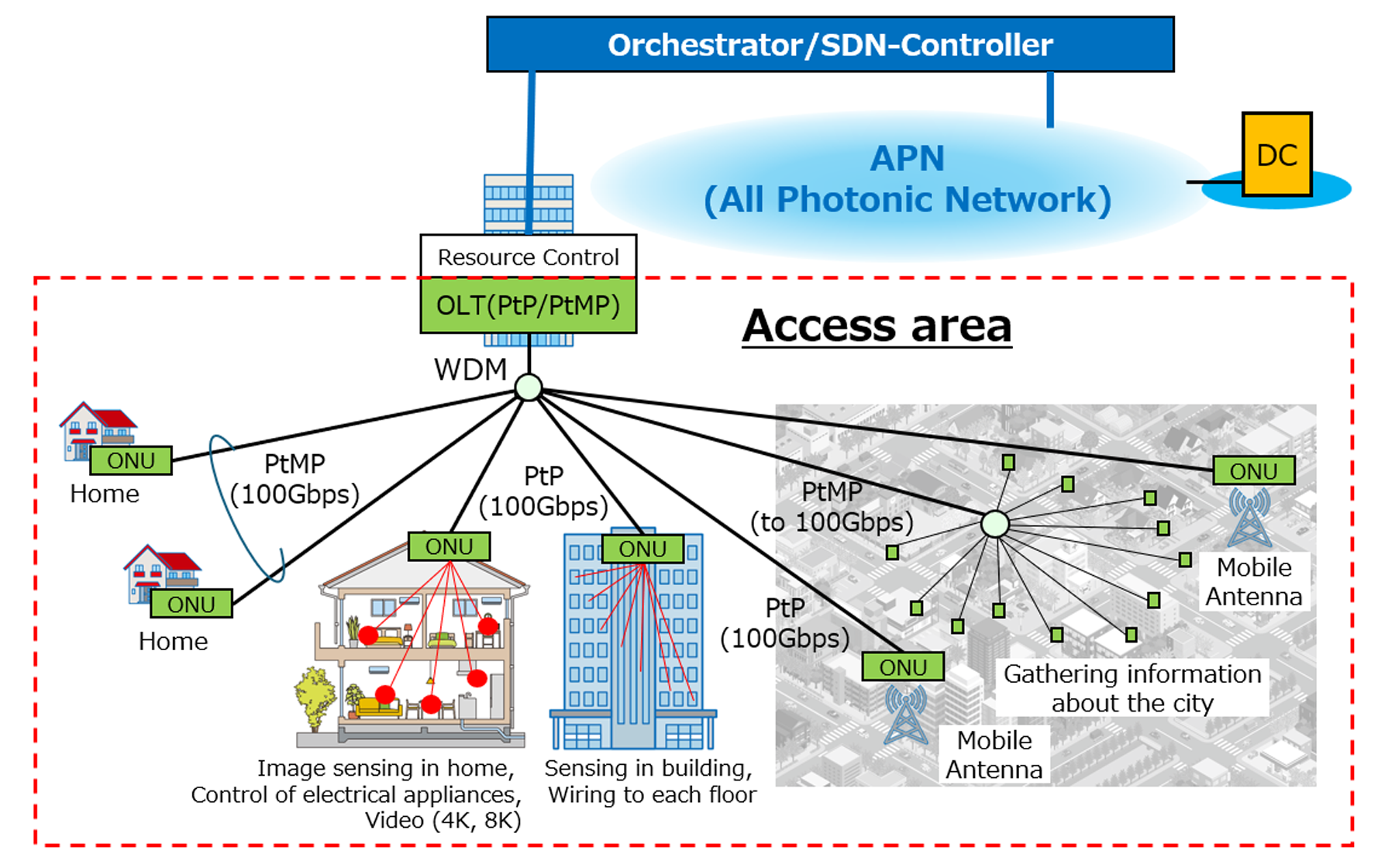
This technology is applicable to the FTTx market for consumer and business customers, as well as the mobile market, within the All-Photonics Network (APN) sector-which enables the communication services provided by telecommunications carriers such as NTT in Japan and AT&T overseas.
Future Vision
Moving forward, we will contribute to the reconstruction of social infrastructure with the goal of achieving carbon neutrality by 2050, in line with the SDGs. Specifically, in addition to next-generation PON systems, we will engage in further research and development as well as product development-including research into use cases that leverage the characteristics of hollow core fibers-with the aim of commercializing 100G-PON and the access systems required for IOWN® services.
Notes
1 Hollow Core Fiber
The core of the fiber is hollow, and the medium that transmits the signal light is air. Since wavelength dispersion and nonlinear phenomena can be drastically suppressed, waveform deterioration is less likely to occur. In addition, the transmission delay is 2/3 of that of single-mode fiber (the optical fiber currently widely used).
2 Optical Spectrum
・O band: Wavelength of 1260nm to 1360nm, used in the PON system
・C band: Wavelength of 1530nm to 1565nm, used in the Dense WDM (DWDM) transmission
・L band: Wavelength of 1565nm to 1625nm, used in the DWDM transmission
3 This technology incorporates some of the results from the Ministry of Internal Affairs and Communications-commissioned research project "Research and Development of Advanced Optical Transmission Technology Contributing to a Green Society (JPMI00316)."
4 IOWN is a registered trademark of NTT Corporation.
5 Other company names and product names mentioned in this text are generally trademarks or registered trademarks of their respective companies.