CINO ism
CINOism Vol. 65, Learning from the Innovation Initiatives of Cutting-Edge Enterprises in Europe — Takeaways from IMSAP Global Studio 2026
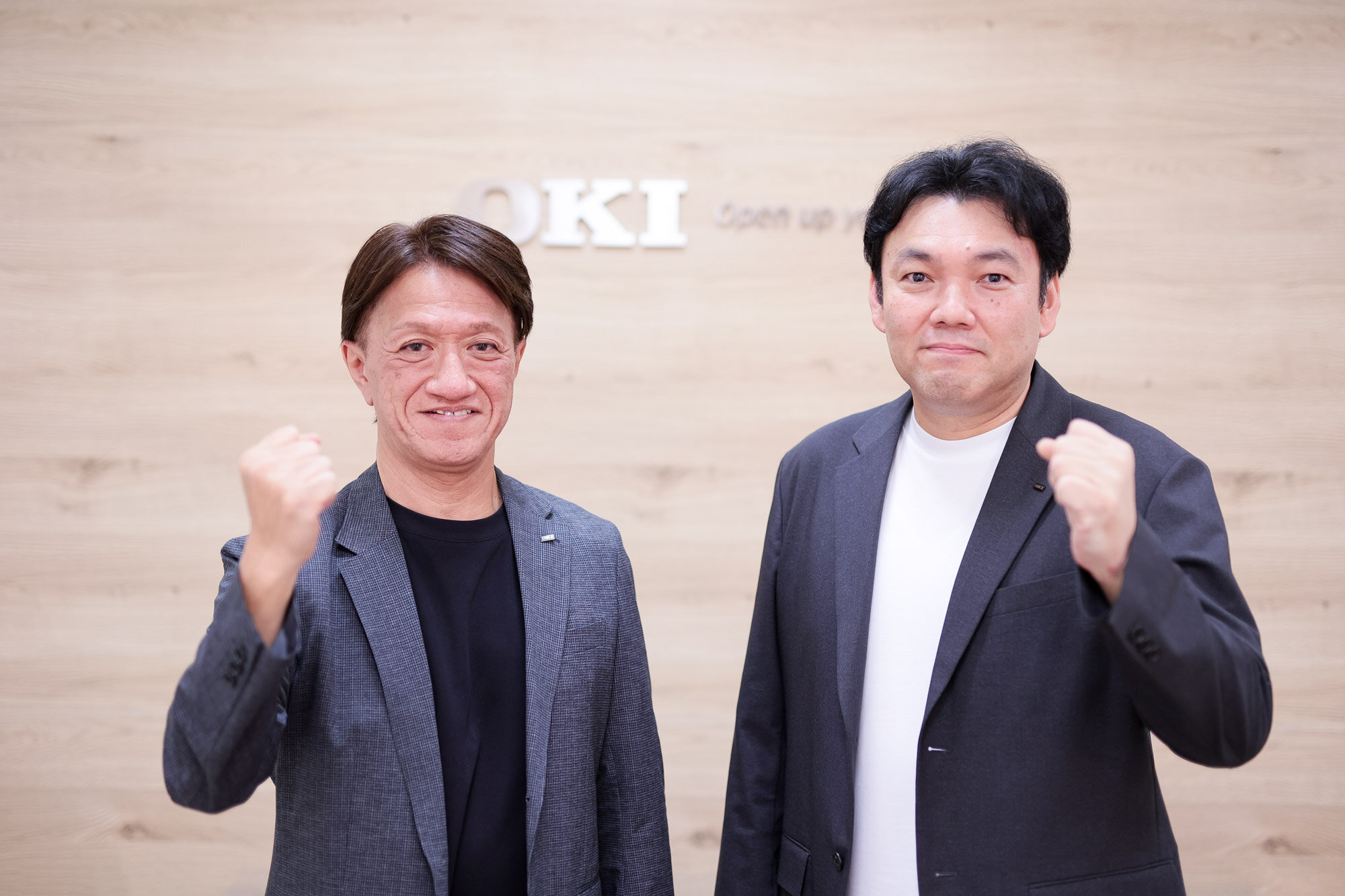
Right: Hideya Takahashi, Senior Manager, Co-Creation Promotion Department II, Innovation Strategy Division
How do global companies that continue to grow envision and practice innovation management? IMSAP Global Studio, organized by the Japan Innovation Network (JIN), is an overseas study program in which participants visit the frontlines of innovation management and learn from these companies’ initiatives firsthand.
In this issue, we speak with Yuhiko Fujiwara, Senior Associate Director, CINO and Head of the Innovation Strategy Division, and Hideya Takahashi, Senior Manager of the Co-Creation Promotion Department II, both of whom participated in IMSAP Global Studio 2026 (on-site visits held May 18–22). Together, we look back on the insights and outcomes they gained from the visit and explore what these experiences reveal about OKI’s future innovation strategy.
Learning from Leading Companies around the World and Putting Innovation into Practice
—— What is the purpose of IMSAP Global Studio 2026?
Fujiwara: IMSAP Global Studio is a program that enables Japanese participants to visit leading global companies and research institutions that practice design thinking, primarily in the Nordic region, where the ideas at the core of the Innovation Management System (IMS) originated. The program brings together around 15 participants from five or six Japanese companies interested in creating new businesses based on innovation and design thinking. I have been participating since its inaugural edition in my capacity as OKI’s head of innovation because I see it as an excellent opportunity to engage with global companies through JIN’s network.
On this occasion, we visited Copenhagen and Billund in Denmark, as well as Lund and Malmö in Sweden. We learned about the initiatives of each organization we visited and held in-depth discussions among participants centered on themes such as organizational innovation and individual leadership.
The five-day schedule, which included travel and covered four cities in two countries, was extremely tight, but we came away with a great many insights. All that traveling, not to mention jet lag, was physically demanding, yet I found the program extremely worthwhile, as what we gained far outweighed the fatigue.
Building an Organization That Supports Innovation from Challenge Exploration to Commercialization
—— What did you take away from the perspective of organizational innovation?
Takahashi: What impressed me most was how the companies we visited built organizations that did not isolate the teams responsible for exploring new business opportunities. For example, at the LEGO Group, a global toy manufacturer, we saw that the transition from a new business team to the relevant business division was not treated as a simple handover. Instead, the two worked together throughout the transition. At Novo Nordisk, a pharmaceutical company, we saw a structure in which members who had gained insights in the upstream stages continued to work alongside the business team through downstream commercialization.
The same thing applies to the co-creation initiatives I am responsible for — our role should not end with handing ideas over to business divisions. Instead, we need to carry the insights gained from challenge exploration and validation through to commercialization. This experience reaffirmed for me the importance of working continuously alongside business divisions to make that happen.
Fujiwara: Organizational innovation has been a theme of this program since it was first launched. At OKI, we’re proud of the steady progress we’ve made using IMS to help build an organization that fosters innovation and transforms our corporate culture.
On this occasion, however, I was particularly interested in how each company approached the newly introduced theme of individual leadership and what initiatives they were pursuing in this area.
360-Degree Leadership: Starting with the Individual
—— What did you take away from the companies’ initiatives in terms of individual leadership?
Fujiwara: I’ve always put greater emphasis on leadership directed toward my subordinates. However, what impressed me, especially at the Danish companies, was the idea that leadership means spending more time engaging with one’s superiors and oneself than with one’s subordinates. I take this to mean that people are encouraged to think deeply for themselves and then actively voice their views to their superiors to make those ideas a reality.
I also heard that in Denmark, children are encouraged from an early age to express their own opinions. I imagine this is why this style of leadership is embraced there without resistance. The visit also gave me fresh insights into how Japanese companies should think about leadership and communication.
Takahashi: What particularly impressed me was the concept of “360-degree leadership” — exercising leadership, starting with oneself, toward one’s superiors, subordinates, and colleagues, and even toward society.
Thinking about my own role, I came to feel that it is important not only to coordinate and oversee co-creation initiatives, but also to engage with management to create the conditions and environment those initiatives need to succeed. At the same time, rather than simply encouraging people on the frontlines to “do their best,” I need to listen firsthand to the problems and challenges they face, organize potential solutions in my own words, and work both upward and across the organization to put them into practice. This experience prompted me to keep asking myself what kind of new leader I should be.
Rethinking OKI’s Strengths and Challenges through Leading Examples from the Nordic Region
—— What are some of the challenges at OKI that came to light through the on-site visits?
Takahashi: What particularly stayed with me was the LEGO Group’s approach to product development. For LEGO, the customer is, above all, children. They observe children’s behavior and thinking very closely and use the insights they gain as a starting point for deciding what value to provide and translating that into product development.
By contrast, at OKI, when developing new businesses and products, we tend to start with the technologies we have — that is, from what we can do. I feel we need to apply a more thoroughly customer-first approach, starting with whom we want to serve and what value we want to deliver to them.
At one of our site visit destinations, we were introduced to a saying often attributed to Albert Einstein: “If I had an hour to solve a problem, I’d spend 55 minutes thinking about the problem and 5 minutes thinking about the solutions.” It reflects the idea that, in solving a problem, it is more important to identify the true problem and understand it in greater depth than to rush into thinking about solutions. Rather than hurrying toward answers, we should spend more time exploring challenges upstream. This approach is also closely aligned with “opportunity identification,” which is a key focus of IMS at OKI. Drawing on what we learned on this trip, I would like to put even greater emphasis on opportunity identification going forward.
Fujiwara: When we visited BLOXHUB* in Copenhagen, Denmark, I was impressed by the ways they ensure that challenges are explored thoroughly. For example, in one of the workshop case studies they introduced, the words “solution,” “technology,” and “data” were banned outright at the start of the discussion. The idea was to keep participants from being drawn into discussions about technology and instead focus first on identifying the challenges that genuinely need to be solved. The idea of starting with challenge exploration is exactly what we practice through design thinking and IMS at OKI, but I feel that it has yet to fully take root. I’m thinking of trying this rule out on a trial basis at one of our upcoming workshops. I’m looking forward to seeing how everyone reacts (laughs).
Our visit to Lund, a university town in Sweden, was also a great source of inspiration. We saw firsthand an industry-academia-government ecosystem that has developed in a planned way around research facilities, with the City of Lund, universities, and companies working together. We were deeply impressed by the scale of that ecosystem.
Turning Lessons from Europe into New Challenges for OKI
—— What are some of the things you would like to incorporate into OKI’s innovation activities going forward?
Takahashi: As the person responsible for promoting co-creation, I want to exercise leadership in creating an academy-like place where we can nurture “future designers” — people who can draw up scenarios by backcasting from the ideal future, then turn their attention to the present and explore the essential challenges we face. I believe the keys will be developing the insight to explore essential challenges and the communication skills needed to bring others on board.
Fujiwara: This study tour reaffirmed for me how much effort growing companies in Europe are putting into building systems that continuously generate innovation, and into putting those systems into practice. This is consistent with the philosophy behind the IMS activities that we at OKI have been pursuing for nearly nine years. Going forward, I would like to further accelerate OKI’s innovation activities while ensuring psychological safety for those who take on challenges. To this end, I would also like to actively incorporate some of the unique approaches I encountered at European companies, such as their ways of thinking about leadership and facilitating discussions, while adapting them to OKI’s own culture and organizational climate.
Another thing I would like to cherish is the connections with people outside OKI that have emerged through this program. Each time the program is held, participants with diverse backgrounds from Japanese companies that are actively pursuing innovation take part. Although they come from different companies, they develop a sense of solidarity as comrades taking on the challenge of innovation together. I would like to nurture these connections rather than let them be one-off encounters and turn them into new opportunities for co-creation in the future.
*The Nordic hub for sustainable urbanization, bringing together companies, organizations, research institutions, and public bodies.
As of October 21, 2026: Yuhiko Fujiwara, Senior Associate Director, CINO* & Head of Innovation Strategy Division
* Chief Innovation Officer