Sustainable Procurement Initiatives
Initiatives to Promote Responsible Corporate Activities
Initiatives to Promote Responsible Corporate Activities
Fulfilling social responsibilities while adhering to laws and regulations, as well as internationally recognized standards related to the environment and human rights, and responding to the diverse voices of stakeholders requires the indispensable cooperation of our business partners within the supply chain. Based on this recognition, OKI established the OKI Group Supply-Chain CSR Deployment Guidebook in 2014 and has implemented the CSR Procurement Promotion Program based on this guidebook.
In year 2025, we will implement a new "Sustainable Procurement Promotion Program" based on the "OKI Group Sustainable Procurement Guidelines," a revised version of the previous guidebook, and work with our suppliers to promote responsible corporate activities throughout the supply chain.
Sustainable Procurement Promotion Program
In fiscal year 2024, when the survey of suppliers under the 3-year CSR Procurement Promotion Program (fiscal year 2021 to 2023) was completed, OKI revised the OKI Group Supply-Chain CSR Deployment Guidebook into the OKI Group Sustainable Procurement Guidelines, taking into account recent developments in international standards related to the environment and human rights. The revision is based on the Responsible Business Conduct Guidelines (Ver.1.1) published by the Japan Electronics and Information Technology Industries Association (JEITA) and refers to the Responsible Business Alliance (RBA) Code of Conduct (Ver.8.0).
At the same time, we reviewed the items and scope of the supplier survey and conducted a pilot survey of some suppliers in February and March 2025 using a new questionnaire (self-evaluation form) to improve the effectiveness of our efforts. We will brush up the questionnaire and survey methods by referring to the feedback from suppliers in the survey, and will promote the new Sustainable Procurement Promotion Program in fiscal year 2025.
Overview of the Sustainable Procurement Promotion Program (FY 2025 to FY 2027)
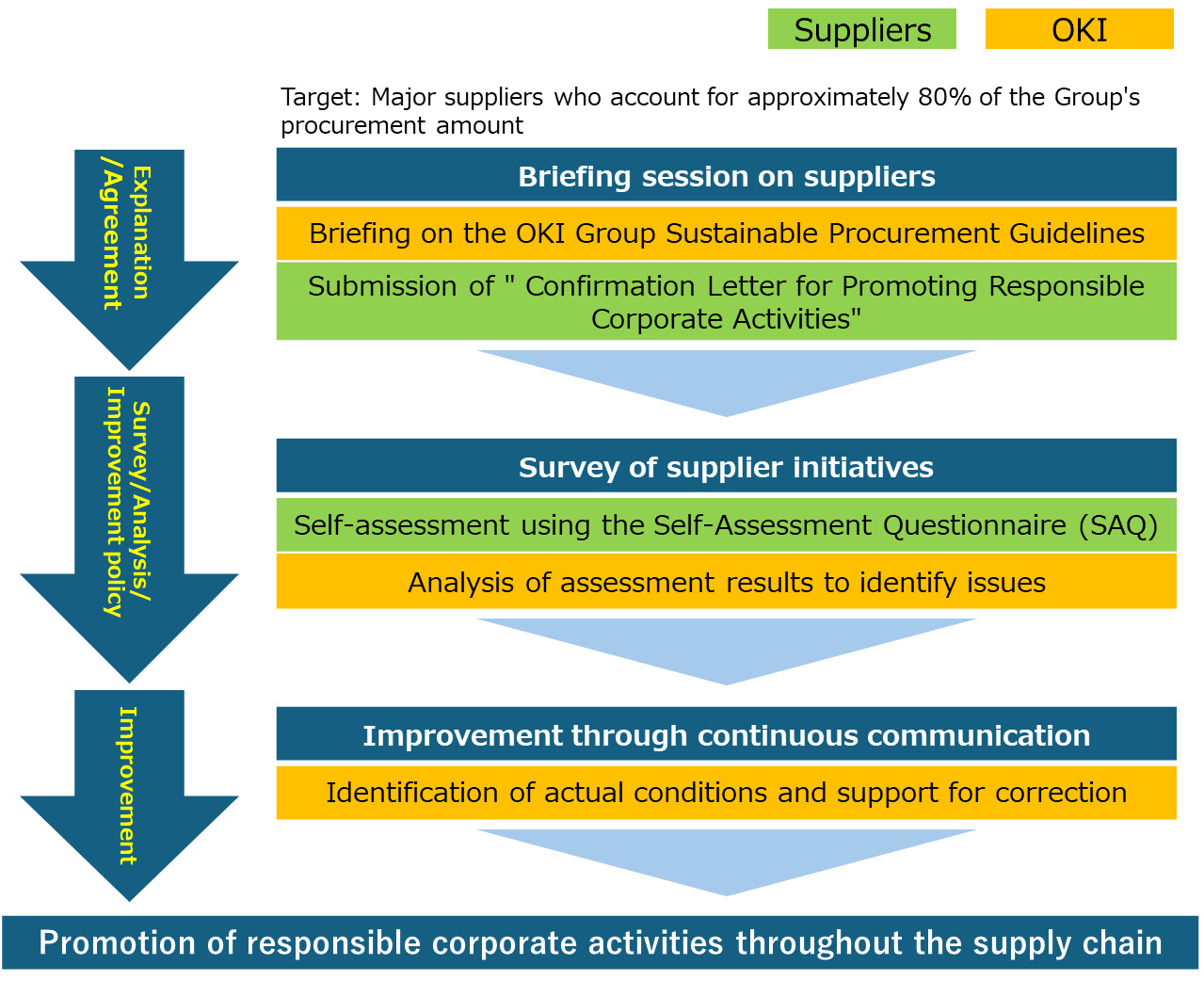
The OKI Group plans to conduct a sustainable procurement survey over a 3-year period targeting approximately 200 of its major suppliers, which account for approximately 80% of the total procurement amount of the OKI Group.
At the supplier briefing held prior to the survey, the OKI Group's sustainability initiatives and the contents of the "OKI Group Sustainable Procurement Guidelines" will be explained to the suppliers, and they will be asked to submit a " Confirmation Letter for Promoting Responsible Corporate Activities". After that, the OKI Group will conduct a survey on the status of its initiatives using a self-evaluation form, with the aim of having all the suppliers complete the survey.
If any problems are identified as a result of the survey, the OKI Group will communicate with the suppliers, such as understanding the actual situation and providing support for correction, in order to make improvements through ongoing efforts.
Sustainable Procurement Promotion Program
Outline of the OKI Group Sustainable Procurement Guidelines
The table below shows the structure of the OKI Group Sustainable Procurement Guidelines. As mentioned above, the guidelines are based on the Responsible Business Conduct Guidelines (Ver.1.1) published by JEITA and refer to the RBA Code of Conduct (Ver. 8.0).
In addition, at the beginning of Chapter 3, “Issues and Explanations for Suppliers’ Cooperation, ” we includ a“ Request to Suppliers ” consisting of the following three items, requesting their cooperation in promoting responsible business behavior throughout the supply chain.
・Suppliers are requested to ensure that they fully understand the “OKI Group Sustainable Procurement Guidelines” and adhere to the items described in Section 1, "Code of Conduct" and Section 2, " Establishing a Management System."
・Suppliers are requested to make these items known not only within their company but also among their own suppliers to ensure their adherence as well.
・The OKI Group may request its suppliers to respond to questionnaires or undergo on-site inspections in order to verify the status of their responsible corporate activities. Suppliers are requested to cooperate when such requests are made.
Structure of the OKI Group Sustainable Procurement Guidelines
| Contents | Outline |
|---|---|
| Introduction | |
| 1. OKI Group Sustainability | Description of OKI Group Values |
| 2. OKI Group Procurement Policies | 1.Basic approach 2. Procurement guidelines 3. Requests for suppliers |
| 3. Request for Cooperation to Our Suppliers and Their Details Section 1: Code of Conduct Section 2: Establishing a Management System Annex Section 1: Description of Code of Conduct Section2: Description of Establishing a Management System |
Code of Conduct 1. Respecting the Laws and Internationally Recognized Standards 2. Human Rights and Labor 3. Health and Safety 4. Environment 5. Fair Trading and Ethics 6. Quality and Safety 7. Information Security 8. Business Continuity Planning Establishing a Management System A. Establishing a Management System B. Supplier Management C. Proper Import/Export Control D. Establishing a Grievance Mechanism E. Disclosing the Activities In addition to the [Code Interpretation] and [Description of Terms] for each item in Part 1 and Part 2, the "Annex" also introduces trends in related international norms. |
Initiatives for Responsible Minerals Procurement
To promote the responsible minerals procurement, the OKI Group is engaged in the following initiatives in accordance with a five-step framework based on the OECD Due Diligence Guidance for Responsible Supply Chains of Minerals from Conflict-Affected and High-Risk Areas.
Step 1: Establish strong company management systems
In the OKI Group Human Rights Policy, as a signatory to the United Nations Global Compact, we have declared our commitment to complying with international norms on human rights, including the International Bill of Human Rights and the International Labour Organization (ILO) Declaration on Fundamental Principles and Rights at Work, as well as to promoting efforts based on the United Nations Guiding Principles on Business and Human Rights. These initiatives are being taken within our sustainability promotion structure, under the leadership of the executive officer in charge of sustainability.
As part of these efforts, the OKI Group Procurement Policies set forth the following: "The OKI Group is committed to responsible mineral procurement activities to ensure that minerals such as tantalum, tin, tungsten, gold, and cobalt contained in our products do not contribute to serious human rights abuses, environmental destruction, corruption, or disputes in Conflict-Affected and High-Risk Areas." We request our suppliers to understand and cooperate with necessary investigations and information disclosure. We also implement the conflict minerals survey upon request from customers and other parties.
Step 2: Identify and assess risks
Using the Conflict Minerals Reporting Template (CMRT) and the Extended Minerals Reporting Template (EMRT) issued by the Responsible Mineral Initiative (RMI), OKI surveys suppliers of components and raw materials used in its products regarding conflict minerals (tin, tantalum, tungsten, and gold, or "3TG") and cobalt. This survey checks whether target minerals are contained; identifies smelters in our supply chain; and checks on the status of responsible mineral procurement initiatives by suppliers. Based on the identified smelter information obtained from the survey results, we conduct risk assessments for individual suppliers and products.
Step 3: Design and implement a strategy to respond to identified risks
Based on the results of risk assessments, we ask suppliers using smelters that may be involved in conflicts to take initiatives to implement responsible mineral procurement activities.
Should a customer express similar concerns to us, we communicate the customer's concerns to suppliers of the relevant products or components and request them to take initiatives.
Step 4: Carry out independent third-party audits
The OKI Group is a member of the RMI, which implements the Responsible Minerals Assurance Process (RMAP), an audit process intended to assure that smelters are not involved in conflicts. We support RMAP audits and promote responsible mineral procurement survey activities in the supply chain.
Step 5: Report annually on supply chain due diligence
On its website, the OKI Group annually discloses information on its responsible mineral procurement initiatives.
FY2024 survey results
In FY2024, we conducted the conflict minerals survey focusing on suppliers to the printer business. We received responses from all subject suppliers and requested corrective measures if they were using problematic smelters. In addition, we appropriately responded to customer inquiries concerning the conflict minerals survey, through means such as submitting reports using the CMRT and the EMRT.
Green Procurement Initiatives
The OKI Group is committed to green procurement by prioritizing the purchase of materials and services with less environmental impact in order to reduce environmental impact and comply with environmental laws and regulations. We ask our suppliers to provide chemSHERPA data and establish and operate environmental management systems in accordance with the OKI Group's Green Procurement Standards.
Please refer to the Green Procurement Standards page for details.